
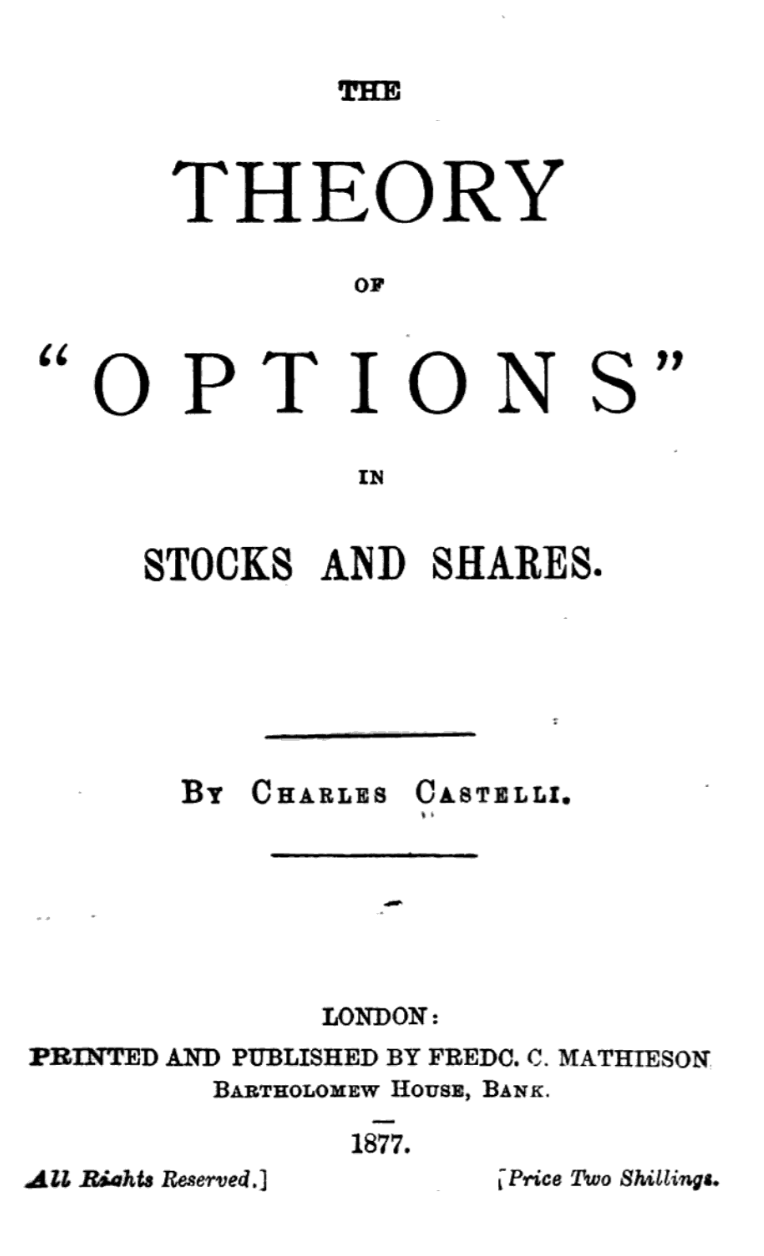


Recently I stumbled upon a rare and singularly important book—one that quietly rewrites the prehistory of modern quantitative finance.
The volume is The Theory of Options in Stocks and Shares, published in London in 1877 by Charles Castelli, a stock and share broker operating in the City. At first glance it looks like a modest Victorian manual: plain typography, ledger-style tables, methodical prose. But on closer inspection it reveals itself as something far more remarkable—one of the earliest systematic attempts to explain options trading as a coherent, internally consistent practice, written nearly a century before Black–Scholes.
What makes Castelli’s book fascinating is not what it contains, but what it does without. There is no probability theory. No stochastic processes. No distributions, no expectations, no integrals. And yet, options are explained clearly, operationally, and correctly. Buyers have limited downside and asymmetric upside. Sellers collect premia and assume contingent risk. Calls and puts are used to express directional views, insure positions, or speculate with bounded loss. The economic logic is precise even if the mathematics is absent.
Castelli’s approach is resolutely practical. Each chapter proceeds by worked examples, laid out almost like double-entry bookkeeping. A stock is bought at a given price. A call is purchased for a stated premium—often quoted as a simple percentage of notional. Time passes. The stock moves. The option is exercised, abandoned, or sold back into the market. Profit and loss are computed explicitly, step by step. There is no abstraction layer separating theory from execution; theory is execution.
Crucially, option premia are not “derived” in any modern sense. They are observed, negotiated, and stabilised by market practice. Premia depend on time to expiry, proximity to the money, and—most tellingly—on the recent behaviour of prices. Volatility is present everywhere in Castelli’s reasoning, but only as lived experience, not as a parameter to be estimated. The market knows when prices are “excited,” “dull,” or “violent,” and option prices respond accordingly. This is implied volatility before it was implied, and long before it was named.
Reading the book with modern eyes, one also encounters proto-arbitrage reasoning scattered throughout. Castelli repeatedly notes that an operator may “cover” an option position by transacting in the underlying stock, locking in gains or limiting exposure. While there is no formal replication argument, the intuition is unmistakable. Hedging exists as a practical activity, not as a theorem. Delta is felt in the hands before it is written on the page.
Historically, the book occupies a pivotal position. Options were traded long before 1877—in Amsterdam, Paris, and London—and earlier writings certainly exist. But Castelli’s work appears to be among the first book-length, systematic, pedagogical treatments devoted entirely to options as financial instruments. It is neither a moral pamphlet nor a legal commentary nor a speculative tract. It is a textbook, written by a practitioner for practitioners.
In this sense, it forms a missing link between early market practice and the later mathematical formalisation of finance. When Bachelier introduces Brownian motion in 1900, and when Black, Scholes, and Merton formalise continuous-time replication in the 1970s, they are not inventing options—they are inventing a language to describe something markets already understood. Castelli shows us what that understanding looked like before probability theory colonised finance.
There is a deeper lesson here, especially for quantitatively minded readers. Modern finance often proceeds as if pricing models are primary and trading is a derived application. Castelli’s world runs in the opposite direction. Prices emerge from practice; theory is an after-the-fact rationalisation. Risk is managed by structure, not by expectation. Scenarios matter more than averages. Losses are bounded by design, not by tail integrals.
In an era increasingly concerned with model risk, regime shifts, and the limits of statistical inference, this Victorian manual feels unexpectedly contemporary. It reminds us that markets functioned—and functioned well—long before elegance entered the equations. Sometimes the most sophisticated ideas arrive first in ledgers, not in symbols.
Castelli did not know he was laying groundwork for a future theory. He was simply describing what worked. And in doing so, he left behind a small, quiet book that deserves a place on the shelf of anyone interested in the true origins of quantitative finance.